Read time: 3 minutes
One in five took time off for stress
Most staff don’t believe their employer takes mental health seriously, and the reason is what they can and can’t see
One in five UK workers took time off sick last year because of poor mental health caused by stress. Among 18 to 24-year-olds, it was two in five (39%).
Only 27% of workers said their employer genuinely prioritises and supports mental health through action and resources. 35% said they wouldn’t feel comfortable telling their manager they were under high or extreme stress.
(Source: Mental Health UK Burnout Report 2026, a YouGov survey of 4,502 UK adults, 2,591 of them workers, carried out in November 2025.)
Employers report something different. In the CIPD’s 2025 survey of HR professionals, 74% said employee wellbeing is on their senior leaders’ agenda. In 2020, it was 61%.
What staff can see
So in most companies, wellbeing is on the leadership agenda, and three in four staff can’t see it.
Staff judge it on what happens in front of them. Does anyone ask how they’re doing? Does the workload change when they say it’s too much? Is it safe to say so at all? A wellbeing policy or a poster for the assistance line doesn’t answer any of those questions.
When a third of people won’t raise stress with their manager, the first sign the manager gets is often a sick note.
What to do this week
Make workload something your team talks about every week. In your one-to-ones or your next team meeting, ask each person: “On a scale of one to ten, how manageable is your workload right now?” Ask it the same way every week.
Give your own number first, and say what’s driving it. That shows the question is safe to answer honestly.
When someone gives a low number, do something about it within the week. Drop a task, move a deadline or share the work out. Staff remember whether anything changed.
Mental Health UK’s chief executive, Brian Dow, says the charity’s workplace training team finds that young people “value regular check-ins on workload and wellbeing”.
To sum up, most employers believe they’ve made mental health a priority, and most staff haven’t seen the evidence yet. A weekly question about workload, and a change when the answer is bad, is evidence they can see.
From the app
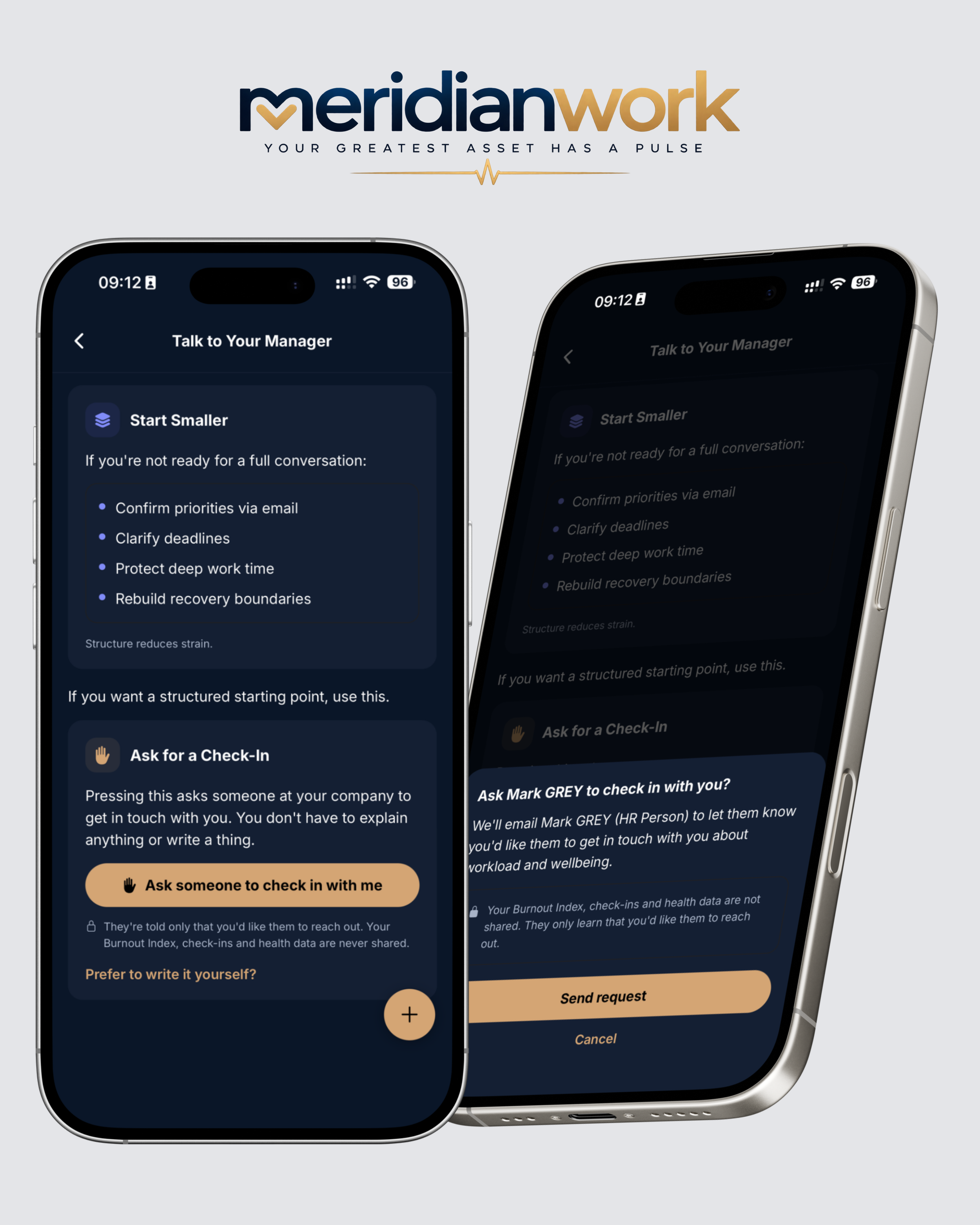
In MeridianWork, anyone can ask for that conversation with one button. On the Talk to Your Manager page, “Ask someone to check in with me” emails a person the company has chosen, such as an HR partner or a mental health first aider, and asks them to get in touch. Only the person’s name and contact details are sent. Their Burnout Index score, check-ins and health data stay private.
Try the app for free: https://www.meridian.work/testing
Join the company waitlist: https://www.meridian.work/#apply
References
Chartered Institute of Personnel and Development (2025) Health and wellbeing at work 2025. London: CIPD. Available at: https://www.cipd.org/uk/knowledge/reports/health-well-being-work/ (Accessed: 6 November 2026).
Mental Health UK (2026) Burnout Report 2026: high stress pushing workers into sick leave as just one in four feel mental health is genuinely prioritised and supported in the workplace. 16 January. Available at: https://mentalhealth-uk.org/blog/burnout-report-2026-high-stress-pushing-workers-into-sick-leave-as-just-one-in-four-feel-mental-health-is-genuinely-prioritised-and-supported-in-the-workplace/ (Accessed: 6 November 2026).
Personnel Today (2025) Sickness absence hits record high. Available at: https://www.personneltoday.com/hr/sickness-absence-2025-cipd-simplyhealth/ (Accessed: 6 November 2026).