Reading time: 2 minutes
The UK’s record sick-day figure is 9.4 days, and a few people account for most of it.
The average UK employee took 9.4 days off sick last year. That’s the highest figure in more than 15 years. It was 7.8 days in 2023 and 5.8 days before the pandemic.
For companies with 50 to 249 staff, it was 9.1 days. In a 50-person company, that's around 455 lost days a year. The government’s Keep Britain Working review puts each sick day at roughly £120 in lost profit, so that’s about £55,000.
The rise isn’t limited to the UK. Germany recorded 14.6 sick days per employee in 2025. In the US, the share of workers off sick in any given week is higher now than it was in 2019.
What the average hides
Very few people take 9.4 days. Most take none, and a small number take a lot.
The clearest UK data on this comes from the public sector. In the Northern Ireland Civil Service in 2023/24, 57% of staff took no sick days. Absences of more than four weeks made up 83% of all days lost, and only 14% of staff had one.
In a 50-person company with the same pattern, about 28 people would take no time off, and about seven would account for most of the 455 days.
Focus on those seven; the signs usually show before the first long absence.
What to do this week
Review your absence records for the last 12 months and identify anyone with three or more separate spells off. In a Dutch study of 3,563 people with that pattern, 19% had an absence of six weeks or more within the next year.
Then watch for the signs that never show up in a spreadsheet. Swedish research found that people who keep coming to work clearly unwell are more likely to be off sick later. The Health and Safety Executive lists arriving later, pulling away from colleagues, mood changes and a drop in confidence as early signs of stress.
Treat any of these as a reason to check in with that person. Talk to them privately this week and ask how things are, at work and outside it. Then ask what would make the next month easier.
Timing matters. The Keep Britain Working review found that 96% of people off for four to six weeks return to work. After more than a year off, fewer than half do.
To sum up, the UK average is a record 9.4 days, and most of those days come from a small number of people. In your company, those people often show signs before they go off sick. Check your records this week, look out for the signs above, and talk to anyone you’re worried about. The sooner you have that conversation, the better their chances of staying at work or getting back quickly.
From the app
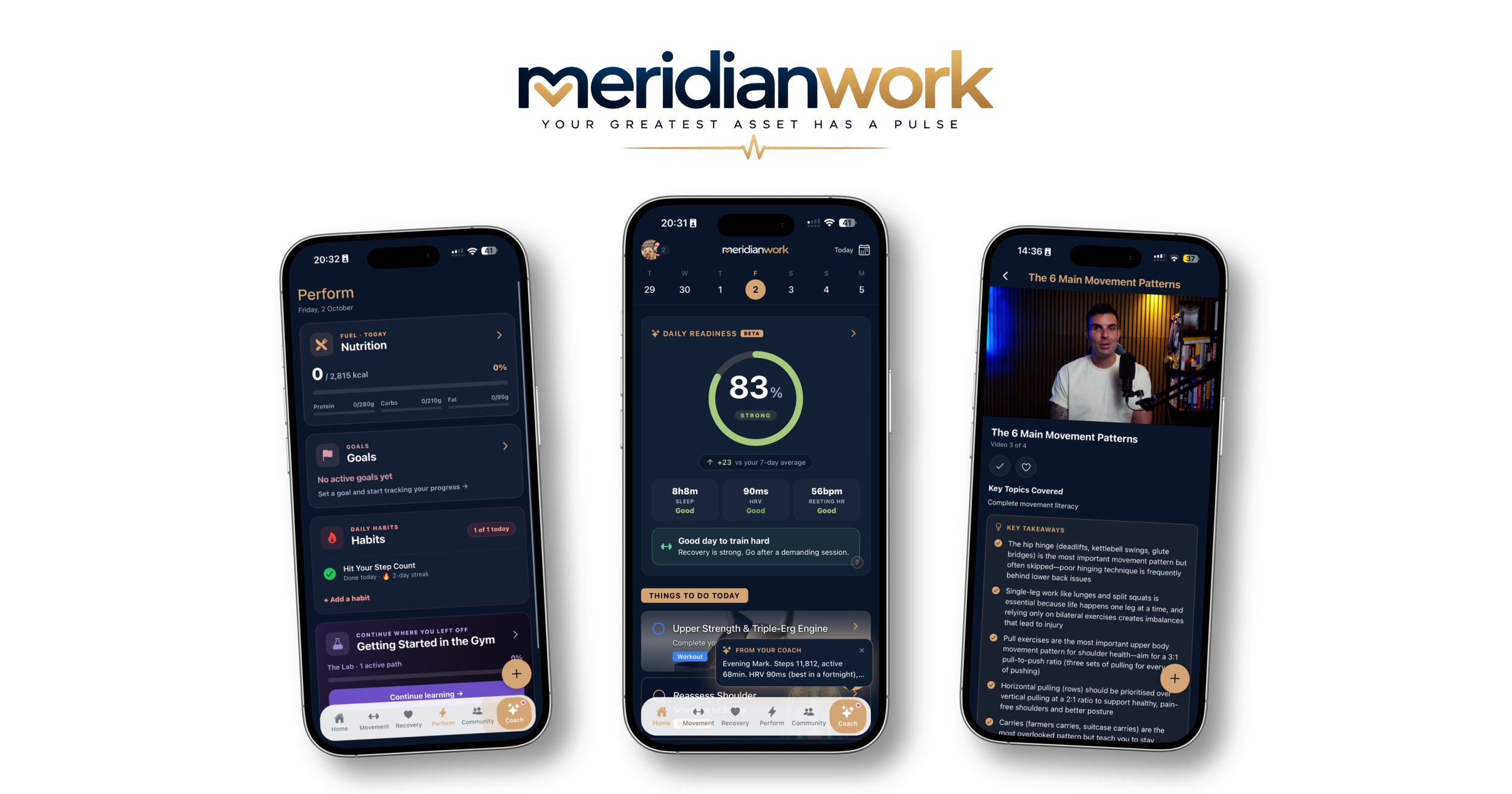
We’ve added a short set of questions to MeridianWork about what builds up before someone goes off sick: commute, sleep, workload, breaks, and being on call. Company reports show results only once at least ten people have answered, so no one’s answers can be traced back to them.
Try the app free: https://www.meridian.work/testing
Join the company waitlist: meridian.work/#apply
ReferencesBureau of Labor Statistics (2020) Labor force statistics from the Current Population Survey: Table 47. Absences from work of employed full-time wage and salary workers by occupation and industry, 2019 annual averages. Washington, DC: US Department of Labor. Available at: https://www.bls.gov/cps/aa2019/cpsaat47.htm (Accessed: 22 October 2026).Bureau of Labor Statistics (2026) Labor force statistics from the Current Population Survey: Table 47. Absences from work of employed full-time wage and salary workers by occupation and industry, 2025 annual averages. Washington, DC: US Department of Labor. Available at: https://www.bls.gov/cps/cpsaat47.htm (Accessed: 22 October 2026).Chartered Institute of Personnel and Development (2025) Health and wellbeing at work 2025. London: CIPD. Available at: https://www.cipd.org/uk/knowledge/reports/health-well-being-work/ (Accessed: 22 October 2026).Health and Safety Executive (2024) Work-related stress and how to manage it. Available at: https://www.hse.gov.uk/stress/signs.htm (Accessed: 22 October 2026).Mayfield, C. (2025) Keep Britain Working: final report. London: Department for Work and Pensions and Department for Business and Trade. Available at: https://www.gov.uk/government/publications/keep-britain-working-review-final-report/keep-britain-working-final-report (Accessed: 22 October 2026).Northern Ireland Statistics and Research Agency (2024) Sickness absence in the Northern Ireland Civil Service 2023/24. Belfast: NISRA. Available at: https://nisra.gov.uk/system/files/statistics/2324-Financial-Year-Absence-Report.pdf (Accessed: 22 October 2026).Notenbomer, A., van Rhenen, W., Groothoff, J.W. and Roelen, C.A.M. (2019) ‘Predicting long-term sickness absence among employees with frequent sickness absence’, International Archives of Occupational and Environmental Health, 92(4), pp. 501–511. doi: 10.1007/s00420-018-1384-6.Statistisches Bundesamt (Destatis) (2026) Indikatoren zur Qualität der Arbeit: Krankenstand. Wiesbaden: Destatis. Available at: https://www.destatis.de/DE/Themen/Arbeit/Arbeitsmarkt/Indikatoren-Qualitaet-Arbeit/Dimension-2/krankenstand.html (Accessed: 22 October 2026).Taloyan, M., Aronsson, G., Leineweber, C., Magnusson Hanson, L., Alexanderson, K. and Westerlund, H. (2012) ‘Sickness presenteeism predicts suboptimal self-rated health and sickness absence: a nationally representative study of the Swedish working population’, PLoS ONE, 7(9), e44721. doi: 10.1371/journal.pone.0044721.